[Automatic translation by Google]
Please provide your feedback about the website at feedback@apc.iisc.ernet.in
The outcome of this project is presented in the form of two papers that were published.
Paper 1: Anand Kumar, M. Gopal Krishna, Debdeep Sarkar, “Automated Design and Inverse Modelling of Metasurfaces using Modified V-shaped Binary Particle Swarm Optimization and Convolutional Neural Networks,” IEEE Trans. Antennas Propag., DOI: 10.1109/TAP.2026.3720832
Paper overview:
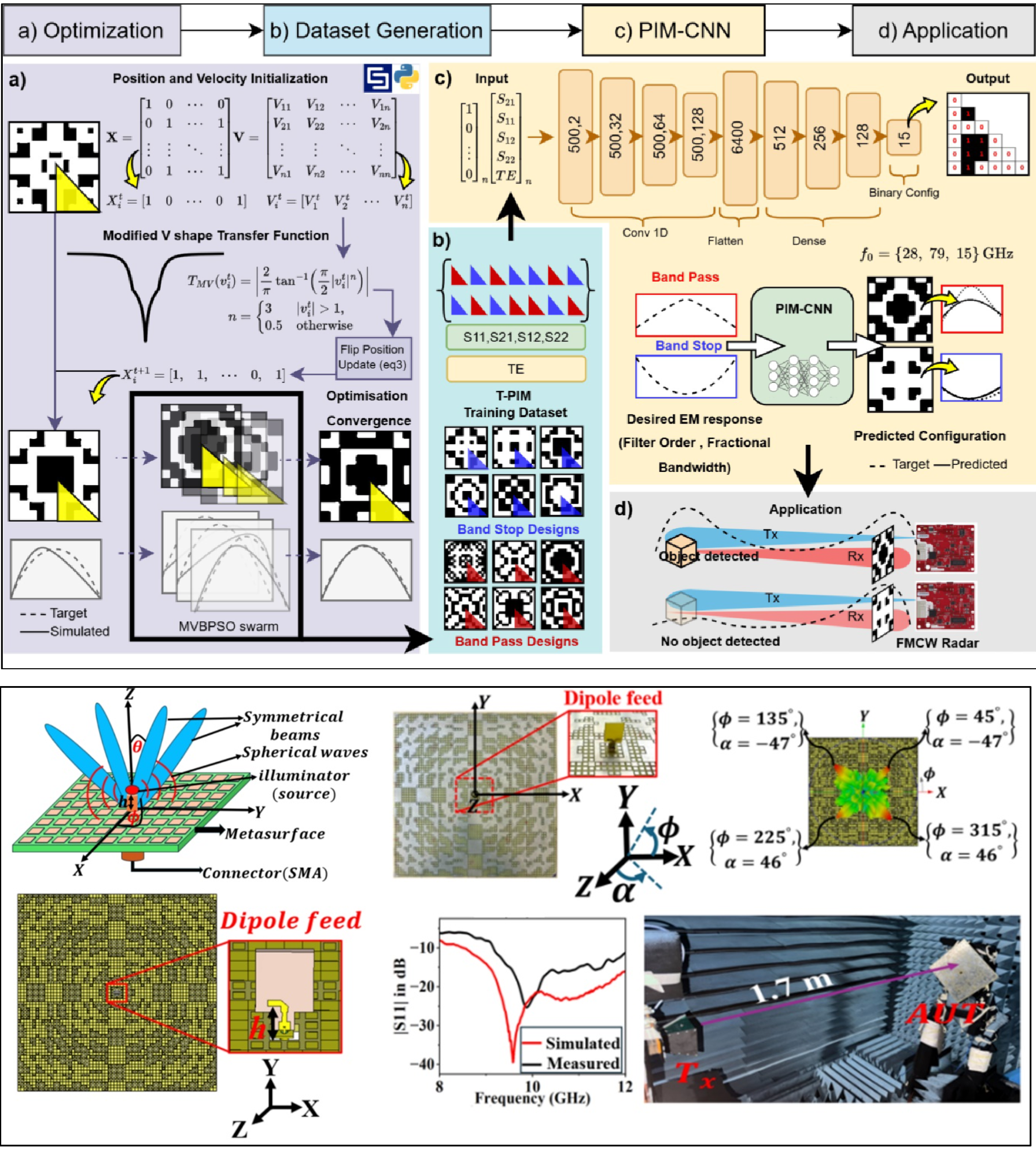
This paper presents a landmark fully-automated framework for the design and inverse modelling of polarisation-insensitive metasurfaces (PIMs) – two-dimensional engineered surfaces capable of precisely controlling electromagnetic wave properties such as phase, amplitude, and polarisation. The work addresses longstanding bottlenecks in metasurface design: the prohibitive cost of full-wave simulations, the inadequacy of continuous optimisers for binary (pixelated) design spaces, and the enormous data requirements of conventional deep learning approaches. The framework integrates three tightly coupled innovations: (1) a theoretically grounded new optimisation algorithm (MVBPSO), (2) a Python–CST automation pipeline for high-throughput EM simulation, and (3) a lightweight convolutional neural network (PIM-CNN) for one-shot inverse design – predicting the physical geometry of a metasurface directly from a desired electromagnetic response.
Modern wireless systems operating at 5G mm-wave (28 GHz), 6G (79 GHz), and automotive radar (77 GHz) frequencies demand metasurfaces with precise spectral filtering properties. Traditional design relies on time-consuming trial-and-error within EM simulation software. Automating this process with machine learning is attractive but faces a fundamental challenge: metasurface unit cells are binary (each pixel is either metal or void), making standard continuous optimisers physically invalid, while deep learning models typically require tens of thousands of simulations to train.
Both optimised (MVBPSO-designed) and predicted (PIM-CNN-designed) metasurfaces were fabricated on FR-4 substrate and measured using a Keysight VNA and standard gain horn antennas. The framework was further validated with a Texas Instruments AWR1843BOOST FMCW radar at 77 GHz, demonstrating real-world sensing control:
Impact and significance: Unlike typical engineering papers that present heuristic improvements, this work derives its core algorithm analytically through seven formal lemmas with mathematical proofs – a level of theoretical grounding rare in the applied EM community. The proven convergence guarantees and the rigorously quantified exploration : exploitation ratio (nearest to 1.0 among all published methods) make this contribution both scientifically principled and immediately practical. The publication in IEEE Transactions on Antennas and Propagation—one of the most selective and prestigious journals in the field—is itself strong evidence of the community’s recognition of this work’s quality and significance.
The work addresses a real and growing need: as 6G, automotive radar, and sensing systems proliferate, the demand for rapid, reliable metasurface design is intensifying. The 50–60% reduction in training data requirements—achieved not by a bigger model but by smarter physics-aware sampling—demonstrates a fundamentally more efficient design philosophy. The open-source Python-CST API (available on GitHub) further multiplies impact by enabling the research community to replicate and build upon this framework.
Paper 2: Raju Malleboina, Debdeep Sarkar, “Single-Feed Near-Field Excited Quad-Beam Metasurface Antenna,” IEEE Antennas and Wireless Propagation Letters, vol. 24, no. 1, Jan. 2025.
Paper overview:
This letter proposes an elegant and highly practical solution to a longstanding challenge in antenna engineering: how to generate multiple high-gain beams from a single, compact, low-cost feed. The proposed design—a single-feed quad-beam metasurface antenna—produces four symmetrical, high-gain radiation beams using a coaxial-fed printed dipole as the sole exciter, replacing the bulky horn or helical antennas traditionally required for such multi-beam systems.
The key innovation is a two-step design procedure: (1) a far-field reflection-phase synthesis using anomalous reflection principles, followed by (2) a near-field correction factor that accounts for the spherical wavefronts emitted by the compact dipole feed. This correction—adapted here for the first time to multi-beam generation—allows the feed to be placed just λ₀/3 above the metasurface, yielding an antenna profile of only 0.33λ₀.
Multi-beam antennas are essential building blocks for next-generation wireless systems. 6G networks must simultaneously serve users across wide angular ranges, MIMO radar systems need to monitor multiple spatial sectors, and satellite communication links require multiple beams for frequency reuse and interference management. The conventional solutions—butler matrices, phased arrays, Rotman lenses—are complex, lossy at mm-wave frequencies, and bulky, making them unsuitable for compact deployments. Metasurface-based alternatives have emerged, but existing designs either use large, high-gain feed antennas placed at great distances (creating physically large systems) or rely on complex holographic surface impedance tensor calculations. This work sidesteps both constraints.
The aperture uses a 1-bit coding scheme: each unit cell exists in one of two states: Element-0 (reflection phase ≈ 0°) or Element-1 (reflection phase ≈ 180°). The 180° phase difference between elements drives anomalous reflection. The elements are square patches on 2.4 mm FR4 (εr = 4.4) with dimensions λ₀/6 at 10 GHz. The 180° phase difference between Element-0 and Element-1 is maintained across a wide oblique incidence range (0°–80°) for TM polarization, ensuring robust beam formation even with the near-field dipole source producing mixed polarisation illumination. The critical insight is that a compact feed close to the aperture does not produce the plane-wave illumination assumed in standard reflectarray design. The near-field correction factor ΦNF adjusts the required phase at each unit cell element to compensate for the path-length variation of spherical wavefronts, enabling accurate beam synthesis from a feed positioned only λ₀/3 above the surface — an unprecedented combination for multi-beam systems.
Impact and significance:
The most striking achievement of this work is reducing the antenna profile to 0.33λ₀ while maintaining competitive gain (11.7 dBi). This is achieved not by sacrificing performance, but by a smarter design methodology: using a near-field correction factor to unlock the use of a compact, low-gain dipole feed. For practical deployment in space-constrained platforms (vehicles, UAVs, 6G base stations, satellites), this profile reduction is transformative.
Faculty: Debdeep Sarkar