[Automatic translation by Google]
Please provide your feedback about the website at feedback@apc.iisc.ernet.in
Breast cancer continues to be the most diagnosed form of cancer in females. It has a comparatively good survival rate and prognosis if diagnosed early and staged accurately. The conventional diagnosis of breast cancer involves histological analysis with hematoxylin and eosin (H&E) staining, followed by immunohistochemical analysis of key biomarkers on permanent tissue sections. However, with respect to surgical margin assessment in the operating room (OR), the standard technique is frozen section examination, a pathological laboratory procedure for comparatively rapid microscopic examination of excised tissue. However, this process involves sending the biopsy tissue from the OR to the pathology labs, with analysis times ranging from 30 min to 2 h per sample.
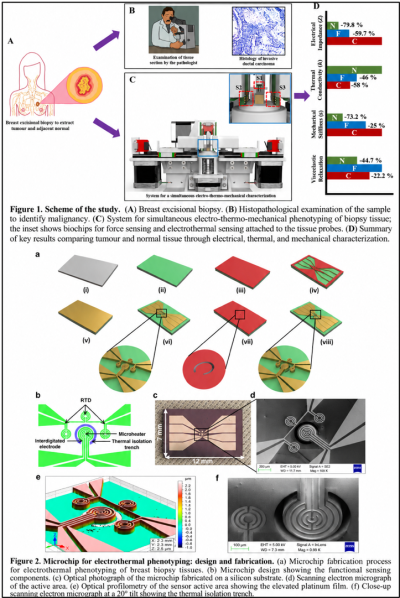
The biophysical phenotypes of breast tissues, such as their electrical, thermal, and mechanical properties (ETM), have the potential to serve as novel markers for differentiating normal, benign, and malignant tissue. In this project, a system-of-biochips (SoB) integrated into a semi-automated mechatronic system to characterise breast biopsy tissues using electro-thermo-mechanical sensing was developed. The SoB, fabricated on silicon using microfabrication techniques, can measure the electrical impedance (Z), thermal conductivity (K), mechanical stiffness (k), and viscoelastic stress relaxation (%R) of the samples. The key sensing elements of the biochips include interdigitated electrodes, resistance temperature detectors, microheaters, and a micromachined diaphragm with piezoresistive bridges.
Publications:
Anil Vishnu G K, Gayatri Gogoi, Midhun C Kachappilly, Annapoorni Rangarajan, Hardik J Pandya, “Label-free multimodal electro-thermo-mechanical (ETM) phenotyping as a novel biomarker to differentiate between normal, benign, and cancerous breast biopsy tissues,” Journal of Biological Engineering, 17, 68 (2023). DOI: https://doi.org/10.1186/s13036-023-00388-y
Anil Vishnu G. K., Gayatri Gogoi, Bhagaban Behera, Saeed Rila, Annapoorni Rangarajan, and Hardik J. Pandya, “RapidET: A MEMS-based platform for label-free and rapid demarcation of tumor from normal breast biopsy tissues,” Microsystems and Nanoengineering, 2022.
DOI: https://doi.org/10.1038/s41378-021-00337-z
Impact and significance: The project developed a silicon biochip platform that integrates electrical, thermal, and mechanical measurements to enable label-free differentiation of normal, benign, and malignant breast tissues. Its research significance is supported by publications in Microsystems & Nanoengineering (2022) and the Journal of Biological Engineering (2023), as well as Indian and PCT patent applications. The platform offers potential for rapid tissue assessment during surgery, addressing delays associated with conventional pathological examination.
Faculty: Hardik J Pandya